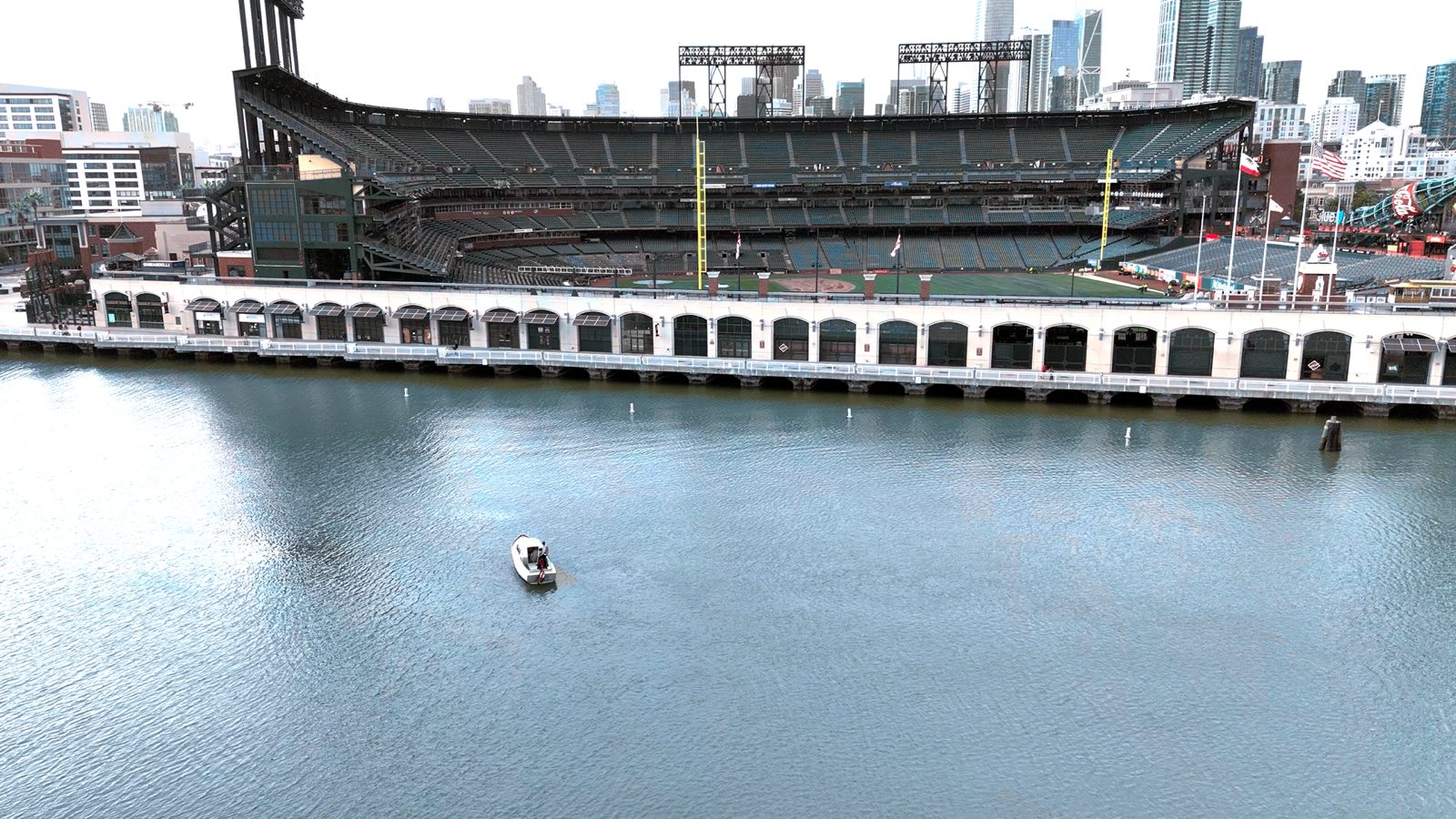
Drone Photography San Diego: Tell Your Brand's Story
A Carlsbad surf shop owner called us in March wanting "drone shots like everybody else is doing." We asked what story he wanted to tell. He didn't know — he just wanted the coastline shot everyone else has. We talked him out of it. Instead we flew his shop at 6:45 a.m. with his crew waxing boards on the sidewalk, the Carlsbad Village Drive storefronts lit up behind them, and the ocean as a backdrop instead of the subject. That clip became his homepage hero and ran for fourteen months before anyone asked for a refresh. Drone photography in San Diego only works for a brand when the drone shows context around the business, not just scenery above it.
By Loren Anderson · October 6, 2026 · 29 min read
Why San Diego's Chaos Is Your Best B-Roll
"Chaos" isn't a knock on the city — it's the Gaslamp crosswalk at lunch rush, the fishing fleet queued at the Tuna Harbor dock, the line outside a Pacific Beach taco stand on a Saturday. That visual density is what separates San Diego drone photography from a stock aerial of any beach town in America. A static, empty coastline shot could be Destin, Florida. A shot of your restaurant's patio packed at golden hour with the Coronado Bridge lit up behind it can only be here.
We shot a fitness studio client in North Park last year this way. Instead of an empty gym exterior, we flew during their 6 p.m. class — fifteen people on the sidewalk warming up, University Avenue traffic streaming past, string lights already on. That footage got used in a Meta ad campaign that pulled a 2.3% click-through rate, nearly triple their previous static-image ads. The chaos wasn't a distraction from the brand. It was proof the brand was real and busy.
The lesson: don't ask a drone pilot to "get the pretty shot." Ask them to get the shot that proves your business is a living, working part of this specific city. That's the brief that produces footage people actually stop scrolling for.
What "Telling Your Brand's Story" Actually Means From 400 Feet
Altitude is a tool, not a destination. A drone at 150 feet reads completely differently than one at 400 feet — the lower altitude still shows faces and signage, the higher one turns your business into a dot on a map. Most brand stories need the lower range, 80 to 200 feet, where a viewer can still tell it's a person doing a job, not an abstract landscape.
We map this out before flying using what we call a three-shot minimum per location: one establishing shot wide enough to show the neighborhood context (Gaslamp's historic facades, Carlsbad's village grid, the Solana Beach train trestle), one medium shot that connects the business to that context, and one close descent that brings the drone down to eye level with the storefront or crew. Skipping the third shot is the single most common mistake — it's the one that actually makes the footage feel like it's about your business and not about San Diego in general.
For businesses that already have ground-level photography, the drone work should visually rhyme with it, not duplicate it. If your existing brand photos are warm and golden-hour lit, the aerial work should match that color temperature rather than looking like a separate, colder dataset bolted onto your site. Related reading: our piece on drone photography and coastal brand chaos walks through matching aerial tone to ground tone in more detail.
Picking Locations That Say San Diego, Not Just "Coastal"
There are maybe six aerial shots every SoCal drone operator has in their reel: Sunset Cliffs, the Hotel del Coronado roofline, La Jolla Cove seals, the downtown skyline from Coronado Bridge. None of those are wrong, but if your business isn't physically near one, using it as backdrop makes the content feel borrowed rather than owned.
Instead, build the location list from your actual footprint. A property management company with units across Mission Hills, South Park, and North Park should fly all three neighborhoods and show the texture difference between them — that's more useful to a prospective tenant than one pretty skyline shot. A contractor working a remodel in Rancho Santa Fe should fly the actual job site, not a generic home exterior stock shot.
Three location categories consistently outperform generic scenery in client results we've tracked:
For more on matching specific landmarks to brand footage, see our guide on optimizing drone shots around SoCal landmarks.
The Permits and Airspace Reality Nobody Mentions
Every business owner who's hired a drone operator has had the same surprise conversation: "we can't fly there." San Diego has more restricted airspace than people assume. MCAS Miramar, Montgomery-Gibbs Executive Airport, and Brown Field all carry controlled airspace that requires LAANC authorization through the FAA before a Part 107 pilot can legally fly, sometimes with altitude caps as low as 100 feet depending on proximity.
Coastal parkland adds another layer. Torrey Pines State Natural Reserve and most California State Parks property prohibits drone launches without a permit, and La Jolla Cove's marine protected status restricts flights that could disturb the seal colony. Balboa Park has its own rules tied to the airport approach path next door. None of this is secret information, but it's also not something most business owners think to ask about until a shoot gets cancelled mid-morning.
Here's the part that actually matters for you as the client: ask any drone operator you hire for their Part 107 certificate number before booking, and ask specifically whether they've checked LAANC authorization for your flight location and date. A legitimate operator will have this answer ready in under a minute. If they hesitate or don't know what LAANC means, that's your sign to look elsewhere — a grounded drone and a denied insurance claim cost more than the shoot itself. Full rules live directly on the FAA's commercial drone operator page.
Planning the Shot List Around Your Business, Not the View
We build every commercial drone shoot around a one-page shot list before anyone drives to the location. It answers three questions: what moment proves this business works, what location context makes it unmistakably San Diego, and what's the backup plan if marine layer or wind kills the primary shot.
A sample shot list for a Solana Beach restaurant client looked like this: exterior wide at 150 feet showing the 101 and train tracks for context, a slow push-in to the patio during the dinner rush, a close descent to the host stand catching guests walking in, and a sunset-timed pullback showing the full block lit up. Four setups, roughly 35 minutes of flight time, edited down to a 45-second hero video and six still frames for the website gallery.
Notice none of those shots are "the ocean." The ocean appears in the background of two of them because that's geographically accurate, not because it was the point. Businesses that build shot lists around their actual operations get usable content on the first flight. Businesses that just say "get some drone shots of the area" usually end up paying for a second shoot once they realize the first one doesn't say anything about them specifically.
Timing: Golden Hour, Marine Layer, and the 20-Minute Window
San Diego's light is generous most of the year, but it's not infinite. Usable golden hour — the window where the sun is low enough to warm everything without blowing out highlights — typically runs about 20 to 25 minutes before full sunset. Miss that window and you're flying in flat blue light that looks fine but not special.
Marine layer complicates summer shoots specifically. From June through August, overcast skies can persist until 10 or 11 a.m. along the coast from Del Mar down through Pacific Beach, then the layer can return by late afternoon. That leaves a middle-of-day window that's workable but flat, or a race against the layer's return right at golden hour. We check the marine layer forecast the morning of every coastal shoot, not the week before, because it shifts daily.
Inland locations — El Cajon, Rancho Bernardo, parts of Carlsbad away from the immediate coast — burn off earlier and hold clear light longer, which is worth knowing if your business has any inland presence at all. A multi-location shoot day often works best scheduling coastal locations for golden hour and inland locations for the clearer midday stretch.
Turning Raw Drone Footage Into Brand Content
Raw aerial footage, on its own, rarely performs. We've tested this directly with client ad campaigns — straight drone b-roll with no human element averaged a 0.9% click-through rate across a batch of Meta campaigns we ran last year. The same locations recut with ground-level footage of people — hands, faces, product — intercut with the aerial context pulled that number to 2.1% on average.
The edit pattern that works most consistently: open on a ground-level human moment (someone opening the shop, a chef plating food, a trainer coaching a client), cut to the aerial establishing shot around the 3-second mark once the viewer already has a person to care about, hold the aerial for no more than 4-5 seconds, then cut back to ground level for the rest of the story. Aerial footage is seasoning, not the meal.
For video-specific pacing and b-roll sequencing, our guide on mastering b-roll for Southern California video covers the cut rhythm in more depth, and if vertical formats matter for your channels, see optimizing drone footage for vertical video.
Where This Footage Actually Works
Social media is where most businesses assume drone content belongs, and it's actually the weakest long-term placement. An Instagram Reel has a shelf life measured in days before the algorithm buries it. The placements that keep paying off for months are the ones tied to search and discovery.
Homepage hero video or imagery is the first. A well-shot aerial-plus-ground hero on a landing page increases time-on-site in nearly every A/B test we've run for local service clients, and time-on-site is a signal that correlates with better rankings over time. Second is the Google Business Profile gallery — Google's own guidance confirms listings with photos and video get more direction requests and website clicks than listings without, and most SoCal competitors still only upload phone snapshots, which makes a genuinely well-composed aerial shot stand out in the pack.
Paid social ad creative is third, and it's where the human-plus-aerial edit pattern from the previous section earns its cost. If your business runs local search campaigns at all, pair this visual strategy with the structural groundwork covered in optimizing your San Diego business website for local search — great footage on a slow, poorly structured site still underperforms.
Common Mistakes SoCal Businesses Make With Drone Content
The most expensive mistake is booking a single flight with no plan for reuse. If you're paying $500-$1,500 for a shoot, that cost should produce a homepage hero, four to six GBP gallery stills, two or three ad creative cuts, and at least one piece of social content — not one 15-second clip that lives on Instagram for a week and disappears.
The second mistake is chasing the generic SoCal shot instead of your specific footprint, which we covered earlier but it's worth repeating because it's the single most common request we get. The third is ignoring airspace and permit requirements and finding out mid-shoot that the location is restricted — we've had to reschedule or relocate shoots on short notice more than once because a client didn't flag a flight path near Montgomery Field.
A fourth mistake, more subtle: shooting only on a bright, clear day. Flat gray marine-layer light actually photographs some subjects — industrial yards, warehouses, parking structures — better than harsh sun, because it removes blown-out highlights and hard shadows. Don't cancel a shoot just because the sky isn't postcard-blue; ask your photographer whether the light actually suits the subject.
Your Next Step
Before you book a drone shoot, write down the three moments that actually prove your business works — not the view from above it, the work happening inside it. Then pick the one San Diego location detail (a street, a bridge, a neighborhood grid) that makes that moment unmistakably local. That one-page brief is the difference between footage that sits on a hard drive and footage that runs on your homepage for over a year. If you want a second set of eyes on that brief before you spend money on a flight, that's a 20-minute conversation, not a sales pitch — bring your shot list and we'll tell you honestly what's realistic given the light, the airspace, and the season.
Questions
Do I need a permit to fly a drone commercially in San Diego?
Yes. Any drone flight for business purposes in the U.S. requires the operator to hold an FAA Part 107 Remote Pilot Certificate. In San Diego, you also need to check airspace restrictions near MCAS Miramar, Montgomery-Gibbs Executive Airport, and Brown Field — large sections of the city sit inside controlled airspace that require advance authorization through the FAA's LAANC system.
What's the best time of day for drone photography in San Diego?
The hour before sunset and the 30 minutes after sunrise give the cleanest light with the least harsh shadow, but plan for the marine layer — June through August it can burn off as late as 10 a.m. and roll back in by 4 p.m., which shrinks your actual shooting window to roughly two hours midday or the last 20 minutes of golden hour.
Can drones fly over La Jolla Cove or Torrey Pines State Reserve?
No, not without special authorization. Torrey Pines State Natural Reserve and most California State Parks property prohibit drone launches and landings without a permit, and La Jolla Cove's marine protected area adds wildlife disturbance restrictions. Check park-specific rules before you build a shot list around either location.
How much does professional drone photography cost in San Diego?
Local rates typically run $500 to $1,500 for a half-day shoot covering both stills and short video clips, depending on location permitting, number of setups, and whether editing is bundled in. Multi-location brand shoots or ongoing retainer work for real estate, hospitality, or construction clients usually land in the $1,500 to $4,000 range per project.
What's the difference between drone photography and drone videography for a brand?
Drone photography captures single high-resolution stills — great for website heroes, print, and Google Business Profile galleries. Drone videography captures moving footage that becomes part of a larger story, usually cut with ground-level b-roll. Most SoCal brand shoots book both in the same flight to maximize the cost of permitting and crew time.
Where should drone footage actually get used after the shoot?
The highest-impact placements are the website homepage hero, the Google Business Profile photo and video gallery, and paid social ad creative — in that order. Organic Instagram posts get the least long-term value because the content disappears from feeds within days, while a homepage hero and GBP gallery keep working for months.
More from the studio